
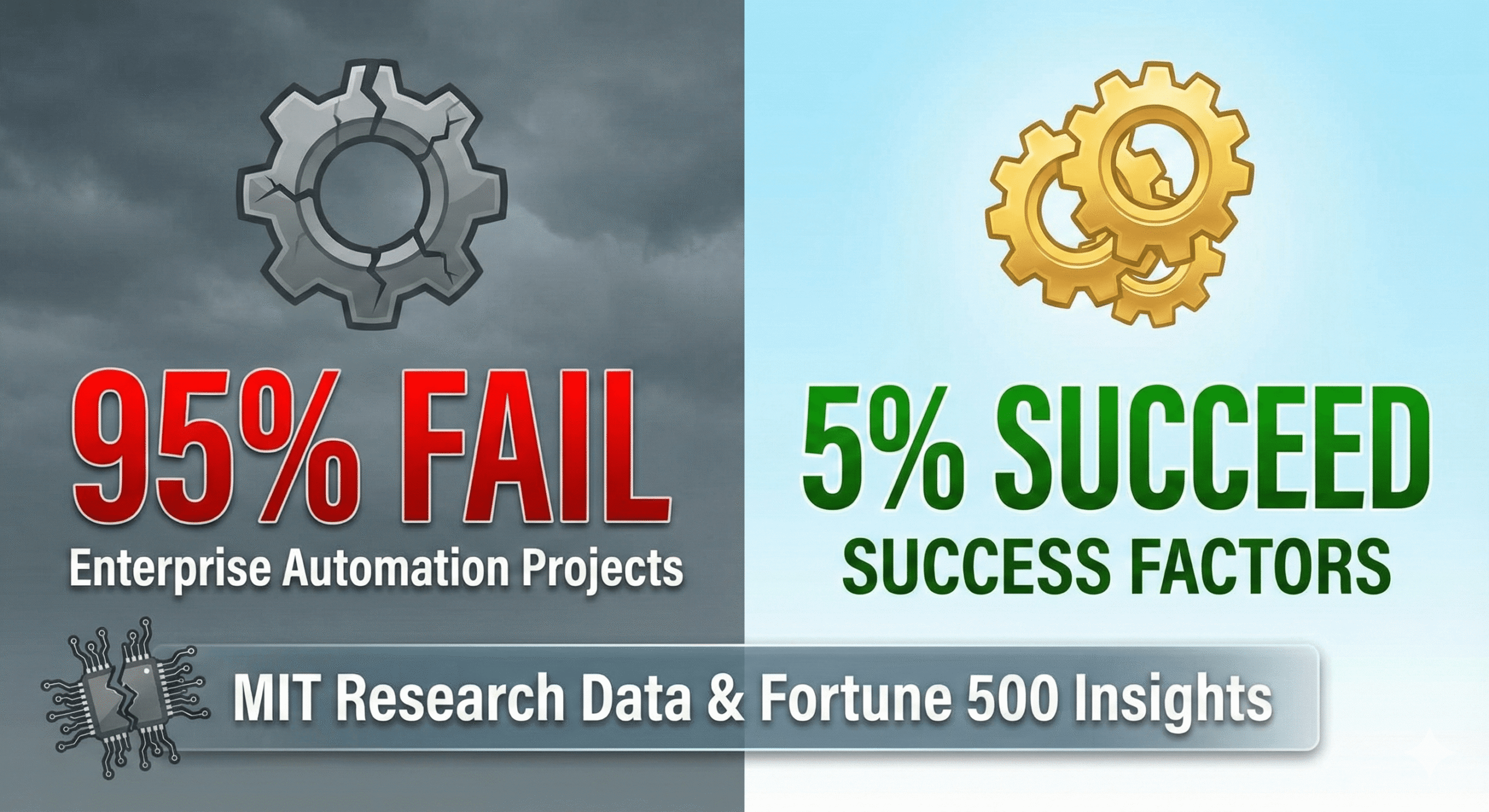
Last year, I sat in a boardroom with a Fortune 500 CIO who’d just killed his third automation initiative in 18 months. Three different vendors, three different approaches, and roughly $12 million down the drain. He wasn’t alone. MIT research shows that 95% of enterprise automation projects either fail outright or deliver significantly less value than projected. That’s not a typo—ninety-five percent. We’re talking about $450 billion in wasted investment annually across global enterprises. Closing that gap usually starts with outside expertise — many enterprises now bring in AI Automation and Agent Consultation before their next initiative to avoid repeating the same mistakes.
Table of Contents
The kicker? Every executive I talk to thinks they’ll be in the 5%. They’ve got better planning, smarter teams, newer technology. Except the data doesn’t care about optimism, and the same patterns keep repeating. Here’s what actually separates the winners from the 95% who crash and burn.
The Real Cost of Automation Failure
When MIT published their 95% failure rate, most people focused on the headline. What they missed was the definition of “failure.” It’s not just projects that get cancelled—though plenty do. It includes initiatives that technically launch but deliver less than 30% of their projected ROI. It covers pilots that run successfully for six months but never scale to production. And it encompasses systems that work exactly as designed but create more problems than they solve.
I watched a retail client spend 14 months building an automated inventory management system. It worked beautifully in testing. In production, it created a cascading failure that took down their entire order fulfillment operation for three days during Black Friday. The automation wasn’t wrong—their process assumptions were.
The hidden costs hit harder than the implementation budget. There’s the opportunity cost of what you could have built instead. The team morale hit when people watch months of work get shelved. The technical debt from half-finished integrations that now need to be maintained. And the organizational scar tissue that makes everyone skeptical of the next automation initiative.
For a $5 billion revenue company, a failed automation project doesn’t just waste the $8-15 million implementation budget. It delays competitive advantages by 18-24 months, which in fast-moving markets can mean losing strategic positioning you never get back.
The 5 Fatal Assumptions Executives Make
Assumption #1: Automation = IT Project (Not Business Transformation)
Most automation initiatives get kicked to IT with a vague mandate to “make things more efficient.” Wrong frame entirely. I’ve seen this play out identically at three different companies: IT builds exactly what was spec’d, it technically works, and the business refuses to use it because nobody involved them in the design.
Automation isn’t deploying software—it’s rewiring how work gets done. That requires business process owners, change management specialists, and governance structures that span departments. When you treat it as an IT project, you get technically correct solutions that nobody wants.
Assumption #2: Technology Will Solve Process Problems
Here’s the thing nobody wants to hear: if your process is broken, automating it just means you’ll fail faster at scale. I watched a financial services firm spend $6 million automating a loan approval workflow that had 23 unnecessary steps and 8 manual handoffs that existed only because of a policy from 1997 that nobody remembered the reason for.
The 5% who succeed do process elimination before automation. They map workflows, question every step, kill what doesn’t add value, and only then figure out what to automate. It’s slower upfront and way less exciting than buying shiny new AI tools. It’s also the only thing that works.
Assumption #3: ROI Appears in Cost Savings Only
CFOs love automation because it promises to cut headcount. That’s the pitch: “Replace 40 FTEs with software, save $4 million annually.” Except when you actually talk to successful automation leaders, they’ll tell you the real value showed up somewhere else entirely—faster cycle times that enabled new product launches, quality improvements that reduced defects by 60%, or data insights that changed strategic decisions.
Delivery Hero didn’t automate to cut costs. They automated to handle 10x transaction volume during peak hours without proportional headcount increases. That’s revenue enablement, not cost reduction. When you optimize for the wrong metric, you build the wrong system.
Assumption #4: Employees Will Naturally Adopt New Systems
I cannot stress this enough: your automation project will live or die based on whether the people who actually do the work want to use it. Not whether they’re forced to use it—whether they want to.
The companies in the 5% bring users into the design process early. They run pilots with real teams doing real work. They listen when someone says “this will break our workflow” instead of explaining why they’re wrong. They invest in training and support, not as an afterthought, but as a core project component with its own budget and timeline.
Change management isn’t about sending emails announcing the new system. It’s about understanding that you’re asking people to fundamentally change how they work, and most humans resist that unless they understand why it makes their life better.
Assumption #5: Pilots Scale Automatically to Production
This one kills more projects than anything else. Your pilot works great with a controlled dataset, 20 users, and an engineer monitoring it daily. Production means 5,000 users, messy real-world data, edge cases nobody thought of, and integration with 47 other systems.
I’ve watched six different companies hit the pilot-to-production wall. The pattern is always the same: successful pilot, executives excited, rush to scale, immediate problems, crisis meetings, and either a long painful fix or project cancellation. The gap between “it works in the lab” and “it works in the real world” is where most automation dreams go to die.
Why the 5% Succeed: The Framework They Use
The companies that make it work aren’t smarter or luckier. They follow a framework that the 95% skip because it seems slow and bureaucratic. Turns out, slow and boring beats fast and broken every time.
Success Factor #1: Governance-First Architecture
Before writing any code, successful companies define who makes what decisions. Not vague “steering committees” that never meet. Actual decision rights: Who approves new automation candidates? Who can kill a project? Who resolves conflicts between departments? Who owns the budget? When questions come up at 11pm on a Sunday because production broke, who has authority to make the call?
Stepstone Group created a three-tier governance model with clear escalation paths. Simple decisions happen at the team level. Cross-functional impacts go to a weekly operations council. Strategic or high-risk calls escalate to executives. That clarity is why they scaled from pilot to production in 90 days while their competitors were still arguing about requirements.
Success Factor #2: Process Elimination Before Automation
The winners spend 30-40% of their project timeline on process mapping and elimination before any automation work starts. They ask brutal questions: Why does this step exist? What happens if we skip it? Who actually uses this output? Can we eliminate this entirely?
A logistics client cut their order-to-delivery process from 14 steps to 7 before automating anything. The automation project took half the time and cost 60% less than originally estimated because they were automating a clean, simple workflow instead of a complicated mess.
Success Factor #3: Orchestration Over Point Solutions
Department-level automation creates isolated efficiency islands that don’t talk to each other. The 5% think in terms of end-to-end orchestration from the start. How does the sales automation connect to order processing? How does order processing trigger fulfillment? How does fulfillment update inventory, which triggers procurement?
You need platforms that orchestrate across systems, not point solutions that solve one problem while creating three new integration headaches.
Success Factor #4: Strategic Change Management
Successful companies treat change management as a project pillar with dedicated resources, not an HR afterthought. They identify champions in each affected team. They run extensive training before launch. They create feedback loops where users can report problems and see them fixed quickly.
Most importantly, they communicate the “why” relentlessly. Not “corporate wants to cut costs” but “this automation eliminates the manual data entry that everybody hates and frees you up for work that actually requires your expertise.”
Success Factor #5: Production-Ready Testing Frameworks
The 5% test for production conditions from day one. Edge cases, security vulnerabilities, compliance requirements, system failures, peak load scenarios—all of it gets tested before launch. They build monitoring and alerting so they know when something breaks before users do.
This seems obvious. Most companies skip it because they’re behind schedule and under budget pressure. Then they launch, hit a problem the first week, and spend six months in crisis mode fixing what should have been caught in testing.
Action Plan: Moving from 95% to 5%
If you’re planning an automation initiative or trying to save one that’s struggling, here’s your 30-day roadmap:
- Week 1: Map your current process end-to-end. Every step, every handoff, every exception. Get the people who actually do the work in the room.
- Week 2: Question everything. Which steps can you eliminate? Which can you simplify? What exists only because “that’s how we’ve always done it”?
- Week 3: Define governance. Who decides what? Who owns the budget? Who can stop the project if it’s not working? Write it down.
- Week 4: Pick your pilot carefully. Choose something with visible business impact but contained scope. Make sure you have executive sponsorship and user buy-in before you start.
And here’s the non-negotiable: do not automate anything until you’ve cleaned up the process. Automating garbage just gives you faster garbage.
The Fork in the Road
We’re at an inflection point. AI-powered automation tools are getting dramatically better and easier to deploy. That’s going to create a bigger gap between companies that know how to implement automation strategically and those that just buy tools and hope for the best.
The cost of waiting isn’t standing still—your competitors are moving. But the cost of failing is worse. A botched automation initiative doesn’t just waste money. It creates organizational skepticism that makes the next attempt even harder.
The difference between the 5% and the 95% isn’t technology, budget, or talent. It’s discipline, governance, and willingness to do the boring work that actually matters.
Resources & Next Steps
At Conversantech, we’ve helped enterprises move from the 95% to the 5% by building automation strategies that actually work in production, not just in PowerPoint. If you’re serious about enterprise automation that delivers real ROI, let’s talk about what success looks like for your specific situation.
Ready to assess your automation readiness? We’ve built a diagnostic framework that tells you exactly where you stand and what needs to change. Reach out—we’ll walk through it together.
Frequently Asked Questions
AI Agents & Automation
Smart autonomous agents for workflow automation, task execution, and real-time actions.

