
Meet Your Toughest Customer.Before They Walk In.
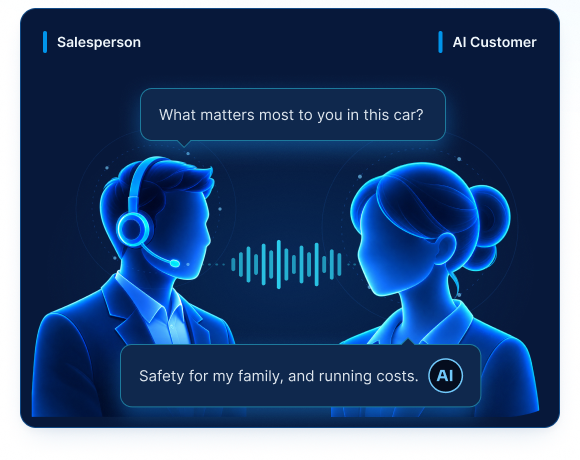
Your salesperson talks to an AI buyer with a background, a budget and a mood, who reacts the way a real one would. Every reply is scored the moment it’s given, using criteria built around your business.

Your products. Your buyers. Your standards.
Illustrative training session

 Live Score
 Coach Notes
 Strong Point
Calm on price. Held steady without discounting early.
 Work On
Features first. Pitched before asking what the buyer needs.
 Next Round
Replay the price objection, and ask first.
Training Teaches the Product. Conversations Win the Sale.
Your team knows the features. What’s harder to rehearse is the pushback: the doubt, the price objection, the buyer who won’t say what they need. Let them face that moment safely, before it costs a deal.
 Slides, brochures and product sessions.

 One role-play with a colleague.
 Results that arrive after the deal is gone.
 The Blind Spot
 Who freezes when the price is challenged

 Who talks features before asking a question
 Who gives up when the buyer pushes back
From Scenario to Score in Three Steps
Set it up around your business. Practise. Learn from every round.
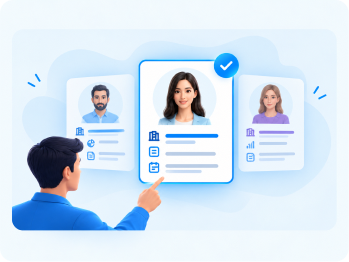
 STEP 01
Pick a Buyer
Choose a customer and situation that match your product, role or training goal.
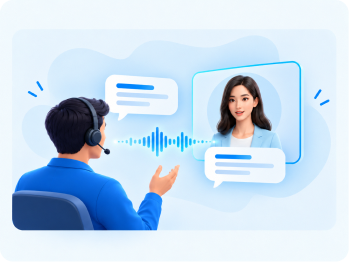
 STEP 02
Hold the Conversation
The AI buyer asks questions, raises doubts and shifts mood as your answers land.
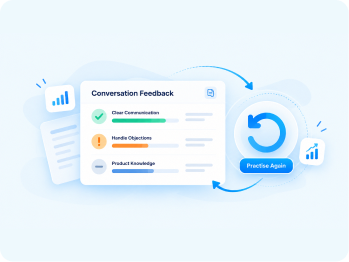
 STEP 03
Read the Score, Go Again
See what worked and what didn’t against your criteria, then rerun and improve.

AI Buyers Built From Your Real Customers
Each AI buyer has a background, a budget, a set of worries and a way of talking. Set them up around the people your team actually sells to.

Who they are
Role, experience and situation.

What they know
How much they already understand.

What they can spend
Budget and price limits.

Sample profile. Details are set with you during solution design.

What they want
Priorities and reasons to buy.

What worries them
Doubts and likely pushback.

How they talk
Tone, pace and decision style.
Turn Each Conversation Into a Coaching Plan
Scores follow the criteria you set. Learners see what worked, what missed and what to rehearse next.




 Sample Evaluation Report

Strengths
Calm under price pressure and clear on product facts.

Focus Areas
Pitches features before asking what the buyer needs.

Next Practice
Ask two discovery questions before explaining any feature.
 Managers start every coaching chat with evidence, not guesses.

Repeat Until It Lands
Rerun a tough buyer as often as needed, with no real sale at risk.

Compare Like With Like
Everyone faces the same buyers, so managers can see who needs what.
Car Sales: Rehearse the Questions Buyers Actually Ask
Practise uncovering what the buyer truly wants, explaining how models differ, and answering questions about price, trade-in and timing.
 The Spec Comparer
 The First-Time Buyer
 The Fleet Buyer
 The Upgrade Hesitator

The Spec Comparer
Researches every model online and arrives with a shortlist. Wants proof, not a pitch.

“Your rival offers more features for less. What am I paying extra for?”

Illustrative training example. Buyer personas, questions, and evaluation criteria are tailored during solution design.
Property Sales: Be Ready Before the Walk-Through
Prepare for the questions buyers bring to a site visit: budget, approvals, handover and whether the home truly suits them.
 The Stretched First-Timers

 The Multi-Generation Family

 The Remote Investor
 The Downsizing Couple

Project Facts
Layout, specs, approvals and handover dates.
Handling Doubts
Price, delays and builder track record.
Understanding the Buyer
Family, budget, loan and timeline.
Building Confidence
Honest answers and a clear next step.

Selling to Businesses
Practise with an AI procurement lead who negotiates price, terms and delivery.

Before a Project Launch
Rehearse pricing, plans and likely objections before the first site visit.
Built for the Teams That Face Customers
Tune scenarios to each team’s conversations and to the skills managers want to grow.
 01
Sales Teams
Rehearse discovery, product walk-throughs, objections and the ask.
 02
Customer Service Teams
Practise calming complaints, explaining fixes and handling frustrated callers.
 03
New Joiners
Get comfortable with common customer questions before the first live call.
 04
Training and L&D Teams
Turn priority skills into repeatable practice with measurable results.
Built Around Your Business. Implemented by Conversantech.
We work with your team to define the training scenarios, shape the learner experience, and implement a solution aligned with your business needs.

Your Products and Buyers
Shape scenarios around your offerings, buyer questions and real selling situations.

Your Scoring Criteria
Agree what good looks like with your sales or training leaders.

Your Team’s Way of Working
Plan learner access, reporting and integrations around how your team already works.

A Step-by-Step Rollout
Start small, review what you learn, and plan the next stage.
Begin With One Team and One Scenario
Pick one conversation your team needs to handle better. Agree the scope, scoring criteria and success measures before you expand.

Learn Your Needs
Identify the team, customer situations, and skills to focus on.

Shape the Pilot
Agree on scenarios, evaluation criteria, deliverables, and success measures.

Build and Test
Configure the experience and review sample conversations and feedback with your team.

Review and Decide
Assess pilot findings and decide what to refine or expand.

What You Receive
 Scenario Design
 Solution Setup
 Scoring Criteria
 Team Onboarding

Answers Before You Book a Demo
Practical answers for teams evaluating AI role-play training. Specific details are confirmed with you when the scope is defined.
01Can the solution be customized for our products and customers?


Yes. Every AI role-play solution from Conversantech is built around your business, not a generic script. We shape the practice scenarios, AI customer personas, buying situations and evaluation criteria around your products, your customers and your training goals, so practice conversations reflect the situations your team actually handles.
02Is the training voice-based, chat-based, or both?
It can be designed for either. The format (voice conversation, text chat, or a mix) is decided with you during solution design, based on how your team speaks to customers and the settings in which your learners will practise.
03Which languages can the solution support?
Language support is defined during solution design. Tell us which languages your customers and teams use, and we will confirm what is achievable for your scenarios, AI customer personas and feedback before a pilot begins.
04How are practice conversations evaluated?
Against criteria you agree in advance. Each conversation is scored on process accuracy (steps, pricing, paperwork, closing), rapport and tone (listening, empathy, confidence), needs discovery and product fit, with clear feedback on strengths, focus areas and what to practise next.
05What can managers review after a session?
Managers see scores for each learner and conversation, strengths, focus areas and what to practise next, so every coaching chat starts with evidence. Because everyone faces the same AI buyers, managers can compare team members like with like.
06Can we start with a pilot?
Yes, and we recommend it. Start with one team and one priority scenario. We agree the scope, evaluation criteria, deliverables and success measures, build and validate the experience with your team, then review the findings and plan the rollout.
07Can it connect with our existing systems?
Integration needs are scoped with you. During solution design we review how your team works, including learner access, reporting and any systems you want connected, and agree what is included so you know the plan before you commit.
08What determines implementation time and cost?
Scope. The main factors are the number of scenarios and AI customer personas, the evaluation criteria, learner access and reporting needs, and any integrations. A focused pilot keeps the first stage small, and we give you an estimate once the scope is defined.
09How are company information and training conversations handled?
How information is handled is agreed during scoping. We define with you what company information and training content is used, how practice conversations are stored and who can see the results, so the setup fits your policies. Contact us to discuss your requirements.
10What is AI role-play training?
AI role-play training lets sales and customer-facing teams practise real customer conversations with an AI-simulated customer, then receive structured feedback against agreed criteria. Instead of reading product material or role-playing with a colleague once, learners can repeat difficult scenarios as often as they need.
11How is AI role-play different from role-play with a colleague?
Role-play with a colleague depends on their time, changes every run and rarely produces comparable feedback. AI role-play gives every learner the same customer persona on demand, repeatable until the answer lands, with feedback measured against the same criteria, so managers see a consistent picture of the whole team.
12Which teams and industries can use AI role-play training?
Sales teams, customer service teams, new joiners and training and L&D teams. The examples on this page cover automobile and real estate sales, and the approach adapts to retail, healthcare, banking and insurance, and B2B services.
